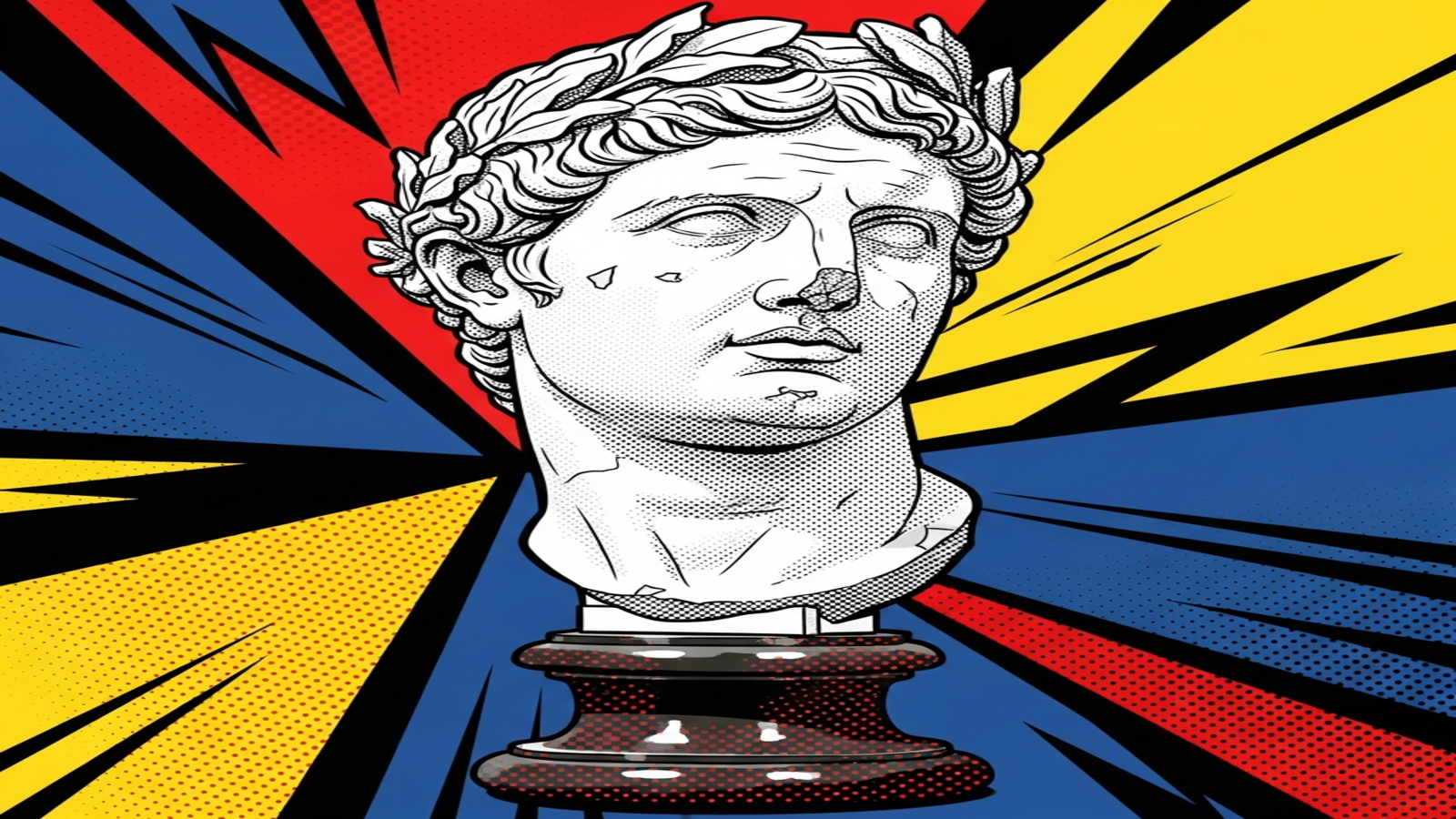
Roman generals returning from war rode through the streets in triumph. Crowds cheered. Gold and prisoners filled the parade. The general stood in a chariot dressed as Jupiter himself.
At the peak of his glory, a slave stood behind him whispering in his ear: Memento mori. Remember, you will die.
The Romans understood something we keep forgetting. Your mind lies to you. Not maliciously. Just consistently. About control. About memory. About who you are and what matters.
They built myths to map these distortions. Gods and monsters that pointed to psychological truths. And two thousand years later, the research confirms they were right.
Here are seven lessons from Roman mythology that psychology has validated. Things you can actually use.
Janus: Thresholds Reset Your Brain
Two-faced god of doorways. One face looked forward. One looked back. He wasn’t just guarding physical thresholds. He represented all transitions. New years. New jobs. Beginnings and endings.
And Romans knew these moments carried unusual weight.
Turns out they were right. Researchers at Notre Dame discovered the doorway effect. Walk through a doorway and you’re significantly more likely to forget what you were just thinking about.
The threshold itself triggers a cognitive reset. Your brain treats it as a chapter break. This isn’t a bug. It’s how your mind segments experience.
Doorways in space. New years in time. These boundaries reshape how you think and remember.
The Fresh Start Effect
This is why January first feels so powerful. Psychologists call it the fresh start effect. Temporal landmarks—beginnings of weeks, birthdays, semester starts—spike motivation.
You’re not the person who failed last year. That was the old you. The threshold gives you psychological distance from past failure. And that distance generates action.
Gym memberships surge. Diets start. The transition itself creates momentum.
But Thresholds Drain You
Every transition asks something of you. What to wear. What to eat. Which direction to go. String together too many and your judgment deteriorates.
Judges reviewing parole cases approve fewer requests as the day wears on, then spike again after lunch. They’re not biased. They’re tired. Decisions burn glucose. Thresholds pile up. You arrive at work already depleted.
So reduce trivial decisions at key transitions.
Steve Jobs wore the same outfit daily. Not because he loved black turtlenecks. Because he understood the cost of deliberation. Protect your cognitive resources for decisions that actually matter.
Let Janus look forward with clarity, not through a fog of breakfast cereal debates.
Fortuna: You Don’t Control What You Think You Do
Goddess with a spinning wheel. She determined your fate. Kings became beggars. Beggars became kings. The wheel turned without pattern or mercy.
Romans understood that luck was real and powerful and completely outside your control.
Except your brain refuses to accept this. You see patterns in randomness. You believe you influence outcomes you don’t.
The Illusion of Control
Psychologist Ellen Langer sold lottery tickets to office workers. Some chose their own numbers. Others got random assignments. Later she offered to buy the tickets back.
The people who chose their numbers demanded far more money. They believed their tickets were more valuable. But a lottery is random. Choosing doesn’t change the odds.
This is the illusion of control. And it’s everywhere.
- Gamblers blow on dice
- Investors think they can time the market
- After a roulette wheel lands on black five times, people bet on red—they think it’s due
But the wheel has no memory. Each spin is independent. This is the gambler’s fallacy. You mistake randomness for a pattern that needs correcting.
Attribution Bias
When things go well, you credit your decisions. When things go poorly, you blame externals.
- You got promoted because you worked hard. You didn’t get it because the boss played favorites.
- Your investment paid off because you researched. It tanked because the market was irrational.
Fortuna keeps spinning, but you narrate the results as if you were steering.
The Solution: Separate Process From Outcome
The solution isn’t fatalism. It’s accuracy. Separate decision quality from outcome luck.
A good decision can have a bad result. A bad decision can have a good result. Poker players call this resulting. They train themselves to evaluate choices probabilistically over hundreds of hands, not by whether one hand won.
The wheel will spin again. Over time, good process beats good luck.
Here’s the paradox: People who acknowledge luck are often more successful long term. They stay humble. They keep learning. They don’t assume the wheel will keep landing in their favor.
Jim Collins found that leaders of companies that went from good to great consistently credited luck and others for success while taking personal responsibility for failure.
Acknowledging Fortuna doesn’t weaken you. It grounds you.
The Vestal Virgins: Credibility Requires Costly Signals
Six women who tended a sacred flame in the center of Rome. If it went out, the city was in danger. These women were chosen as children and served for thirty years under a vow of chastity.
If they broke that vow, they were buried alive. If the flame went out, they were whipped. The role was both honored and terrifying.
Why did Romans invest so much in six women and a fire?
Because visible sacrifice creates credibility.
Costly Signaling
The Vestals were costly signals. Their vow required genuine sacrifice. Marriage. Children. A normal life. All gone.
You can’t fake that commitment. And because you can’t fake it, people trusted them. When a Vestal testified in court, her word carried weight. When she interceded for a prisoner, it mattered.
Her credibility was purchased through visible, ongoing sacrifice.
This is called costly signaling. A peacock’s tail is enormous and makes the bird vulnerable to predators. But that’s why it works. Only a genuinely strong peacock can survive with that handicap. The cost makes the signal honest.
The Vestals were human peacock tails.
Modern Applications
Modern institutions use this. Universities invest in buildings and endowments built over centuries. They can’t easily vanish. That costly commitment makes them credible.
A fly-by-night diploma mill has no such investment. It can disappear. So people don’t trust it the same way.
If you want to be seen as credible, make a visible, meaningful investment that others can observe and you can’t easily fake or abandon.
It might be time. Money. Reputation. But it has to cost you something real. That’s how trust is built.
Cheap apologies don’t rebuild relationships. Words without consequence don’t work. The Vestals knew this. Their entire lives were the signal.
Saturn’s Golden Age: Your Nostalgia Is a Trap
Romans told stories about a perfect past. Before the Republic, before the kings, Saturn ruled Italy. No one owned property. The earth gave fruit freely. No laws were needed because there was no crime. Everyone lived in harmony.
Paradise.
Then it ended. The golden age gave way to silver, bronze, iron. Each age worse than the last. By the time Romans told this story, they believed they lived in the worst age.
The perfection was gone forever.
Rosy Retrospection
Every culture has this myth. Every generation believes it. The past was better. People were kinder. Life was simpler.
Psychologists call it rosy retrospection. You remember the past as better than it actually was. Your brain doesn’t store neutral recordings. It stores reconstructions biased toward making the past look rosier.
The bad parts fade. The good parts intensify.
This scales up to collective nostalgia. Make America great again. Take back control. The language is always backward.
But the golden age never existed.
The nineteen fifties had prosperity for some and segregation and nuclear terror for others. Victorian countryside meant poverty and disease. Saturn’s reign was fiction.
The Reminiscence Bump
Part of it is the reminiscence bump. You remember adolescence and early adulthood most vividly. That’s when you form identity. Everything feels intense.
So when you look back, that period glows. And you mistake the intensity of youth for the quality of the times.
Baby boomers romanticize the sixties. Generation X the nineties. Each group thinks their era was better. But really, being sixteen was better. The era is incidental.
The Antidote
The antidote is examining the past honestly. Read diaries from the era you romanticize. Look at mortality statistics. Understand daily life.
Every era had suffering. The golden age dissolves under scrutiny.
Focus on trajectory instead. Are we solving problems? Are we learning? The direction matters more than the snapshot.
The Lares: Small Rituals Compound
Household gods. Small spirits in every Roman home. In the hearth. The doorway. The pantry. Romans honored them daily with tiny offerings. A bit of food. A splash of wine.
These rituals took minutes but were constant. Day after day. And in return, the Lares protected the home.
Modern psychology confirms it. Small repeated rituals shape behavior far more than occasional grand gestures.
Habits, Not Willpower
Roughly forty to forty-five percent of daily behavior is habitual. You’re not making conscious decisions. You’re running patterns.
And habits are built through context and repetition, not willpower.
The Lares worked as environmental cues. The small shrine—the lararium—prompted the behavior. This is how habits form:
- The cue triggers the routine
- The routine delivers a reward
- The loop strengthens
If you want to build a habit, link it to a clear cue. Not “I will exercise.” But “After I pour coffee, I will do ten pushups.”
The Lares functioned exactly this way.
Start Small
The offerings were small. Not sacrificing bulls. Just a piece of bread. A few drops of wine. The cost was minimal. Consistency was everything.
Research shows big ambitious goals often fail because they require too much effort. Small easy actions succeed because they repeat indefinitely.
Start with one tooth, not perfect flossing. One breath, not thirty-minute meditation. Establish the pattern. Scale later.
Ritual as Meaning
These rituals also carried meaning. You were honoring the gods of your home. This transformed mundane actions into something larger.
When you turn behavior into ritual, you change its psychological weight. Athletes have pre-game rituals. Musicians warm up. Surgeons follow protocols.
These reduce anxiety, increase focus, improve performance. The Lares ritual did this for daily life. It marked transitions. Created structure. Freed up cognitive resources.
Minerva’s Owl: Wisdom Comes Late
The goddess of wisdom had a sacred bird. But the owl didn’t fly at dawn. It flew at dusk.
Wisdom comes late. Understanding arrives after the fact. You don’t understand what you’re living through while living it. You understand later. Looking back. When it’s too late to change course.
Hindsight Bias
After an event, it feels inevitable. You believe you knew all along. But this is illusion. Before the event, the outcome wasn’t clear.
Hindsight collapses possibilities into a single path and makes it look predetermined. This distorts learning. If you believe you knew, you don’t examine why you failed to act. You just blame yourself without getting smarter.
The Curse of Knowledge
Related is the curse of knowledge. Once you know something, you can’t imagine not knowing it.
Teachers struggle with this. Experts struggle. What seems obvious to you now wasn’t obvious when you started. You’ve forgotten what it was like not to know.
Dunning-Kruger
The owl flies at dusk because wisdom requires distance. You can’t see the shape of something while inside it. This is the tragedy of human knowledge. We’re always catching up with our own experience.
The least skilled are most confident because they lack the ability to recognize what they don’t know. This is Dunning-Kruger.
As you gain expertise, you encounter complexity you couldn’t see before. Confidence drops. You realize how much more there is to learn.
The Partial Solution
The partial solution is intellectual humility. Assume you don’t yet know what you don’t know. Act, but build in feedback. Test assumptions.
Don’t wait for the owl, but acknowledge it hasn’t flown yet.
Create space for reflection. Journaling. After-action reviews. Without reflection, experience doesn’t teach. It just accumulates.
The owl needs dusk. It can’t fly in constant daylight.
Genius Loci: Places Shape You
The spirit of the place. Romans believed every location had a presence. A grove. A spring. A building. These weren’t metaphors. Places had character.
And character shaped you.
Modern psychology confirms it. Environmental psychology. Place attachment. Where you are shapes what you think, how you feel, who you become.
Immediate Cognitive Effects
Places shape cognition immediately:
- A messy room generates more creative ideas than a tidy room. Disorder frees thinking. Order promotes conventional behavior.
- Cathedrals have high ceilings to evoke awe.
- Courtrooms intimidate with elevated judges and rigid formality.
- Casinos remove windows and clocks so you lose track of time.
The place cues mental states.
Restorative Environments
Certain environments restore you. Nature especially. Time in natural settings lowers stress, improves mood, restores attention.
Urban environments demand focus. You filter noise. Navigate obstacles. This depletes attention.
Natural environments engage effortless attention. You wander. The place holds you without demanding effort.
This is why burned-out people seek parks and forests. They need a place whose spirit restores what was lost.
Historical and Personal Weight
Places also carry historical weight. A battlefield. A memorial. The genius loci is shaped by what happened there.
And badly designed spaces make people miserable. Hostile architecture says you don’t belong. Surveillance creates paranoia.
Good design creates places where people thrive. Parks with benches. Streets with wide sidewalks. Buildings with natural light. The spirit is welcoming.
Your home accumulates meaning over time. Objects. Arrangements. Memories. The genius loci becomes deeply personal. It reflects you. It holds you.
This is why displacement is traumatic. You lose not just physical space but the spirit that held your identity.
And creating space is self-definition. How you arrange your environment says who you are and who you want to become. You shape the spirit. The spirit shapes you back.
Seven Lessons
- Transitions carry weight
- Randomness deceives
- Credibility costs
- Nostalgia traps
- Small rituals compound
- Wisdom comes late
- Places shape you
The Romans weren’t primitive. They were observing the same psychological terrain you walk. They just drew the map in myths instead of studies.
The territory hasn’t changed. Thresholds still reset your mind. Fortune’s wheel still spins. The Vestals still show that trust requires sacrifice. Saturn’s golden age still never existed. The Lares still wait for daily attention. Minerva’s owl still flies at dusk. And genius loci still lives in every place you enter.
These aren’t ancient superstitions. They’re patterns. And the patterns are still here. Still shaping your decisions, relationships, sense of self.
You can ignore them. Or you can use them.
Build your life with the same attention Romans brought to their household shrines and boundary stones and temple doorways.
The myths were tools. Psychology wrote the manual. You have both now.